What I Learned Building an AI Agent Startup in 30 Days (EasyClaw)
On February 7, 2026, I launched an AI startup. Not after months of planning. Not after raising funding. Not after building a polished product. I built the first version in 12 hours.
The idea was simple: make OpenClaw usable for normal people. OpenClaw is an incredibly powerful framework for AI agents. But for most people, actually using it requires dealing with things like:
- server infrastructure
- VPS setup
- model configuration
- Telegram bot creation
- environment variables
- deployment issues
In other words: too much friction. At the same time, I kept seeing excitement around OpenClaw everywhere. People wanted to use it. They just couldn’t get it running. So I built EasyClaw. A hosted version. Ready to run. No setup required. Just connect and start using it.
Building the MVP in 12 Hours
The first version of EasyClaw was built in a single day. My stack was simple:
- Next.js for the frontend and backend
- Supabase for authentication and database
- Stripe for payments
- Telegram for the chat interface
- OpenClaw running on a VPS
I built everything completely solo. No team. No funding. No roadmap. Just curiosity and speed. And as soon as it worked, I launched it.
Launching Without a Big Plan
The first places I shared EasyClaw were: LinkedIn, Twitter. After that, I started posting in: IndieHackers, Reddit.
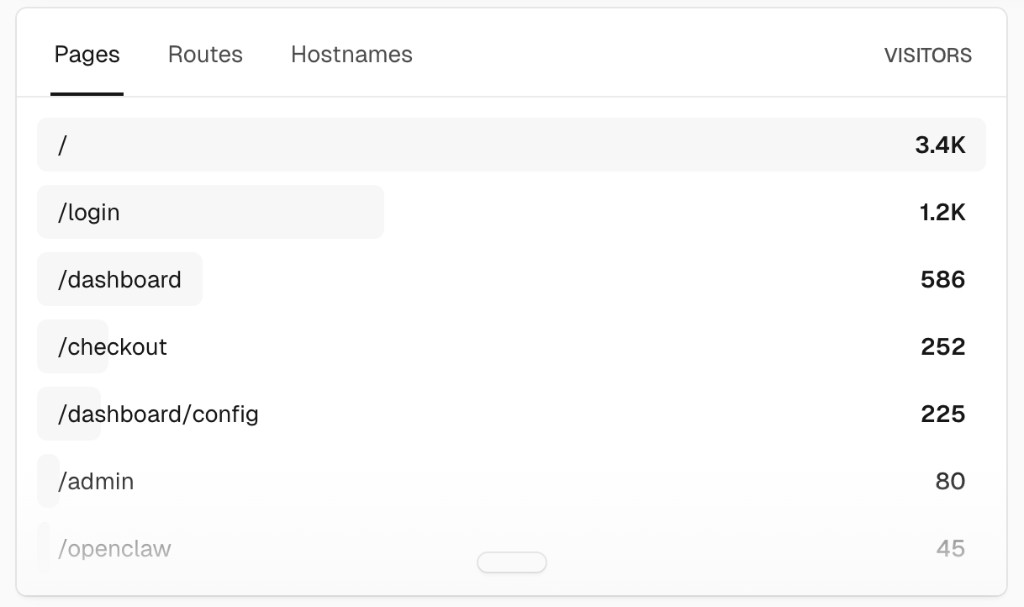
What surprised me the most was where the traction actually came from. It wasn’t from large social networks. It was from Reddit, particularly the /openclaw subreddit. It’s still a small community, but extremely targeted.
That experience reinforced something I’ve learned many times before: Distribution often matters more than the product itself. Large platforms are noisy. Small communities with a shared interest can generate much stronger engagement.
The First Month of EasyClaw
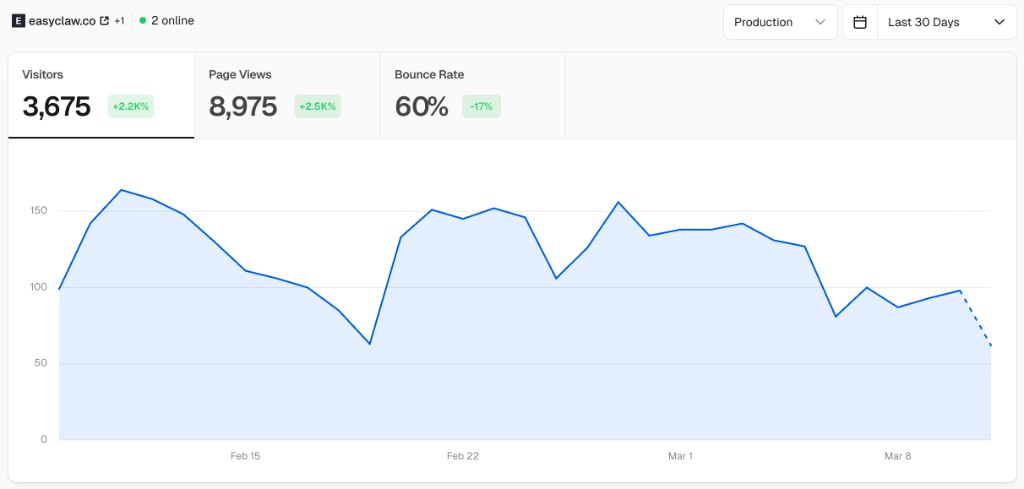
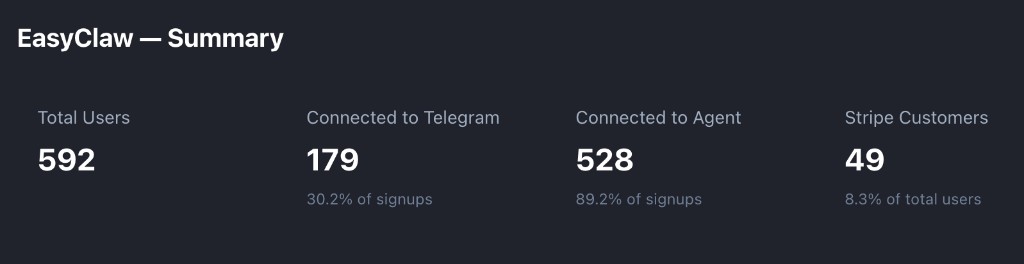
EasyClaw has now been live for about one month. The analytics graphs I’m sharing below show the last 30 days, but the project actually launched on February 7. Here are the numbers so far:
- 3,675 visitors
- 8,975 page views
- 592 users signed up
- 179 connected their Telegram account
- 528 connected to an AI agent
- 49 Stripe checkout attempts
- 6 paying users
For a one-month experiment, I consider this a strong early signal. Not because of revenue. But because people actually tried the product, connected agents, and explored the idea. That kind of curiosity is what early-stage products are built on.
The Onboarding Lesson
One of the biggest problems early on was onboarding. Initially, users had to: create their own Telegram bot, configure tokens, connect multiple services. This created friction. And friction kills early products. So I simplified everything. Now the flow looks like this:
- Click Connect Telegram
- The agent is already configured
- Start using it
No bot creation. No complicated setup. Just removing that one step significantly increased the number of successful Telegram connections. Sometimes growth is just removing unnecessary complexity.
My $313 AI Mistake
One of the most painful lessons came from a configuration mistake. Early in the project, I misconfigured how OpenClaw’s heartbeat system interacted with EasyClaw. Heartbeat systems are designed to keep agents alive and responsive. But in my architecture, I had:
- OpenClaw’s internal heartbeat
- plus an additional layer of activity monitoring inside EasyClaw
This resulted in unnecessary AI calls happening repeatedly. In a single day, token usage exploded. The result: A $313 AI bill. Not a great feeling for a product that had just launched. But it forced me to rethink the architecture. After fixing it:
- unnecessary calls were removed
- token usage dropped dramatically
- the system became far more efficient
Sometimes mistakes like this are simply expensive architecture lessons.
The Positioning Problem
Another lesson appeared quickly. Many users didn’t fully understand what OpenClaw is actually for. Some assumed EasyClaw was just: “another ChatGPT interface.” Which is not the goal. The real potential of agent systems like OpenClaw is in things like:
- persistent agents
- automated workflows
- proactive actions
- background tasks
But those use cases are still new for many users. That means the product needs to do a better job explaining why agents matter. This will be one of the biggest improvements in the next version.
Competition Appeared Immediately
Something interesting happened shortly after launching. Within days, I started seeing several other projects appear with: similar ideas, similar messaging, sometimes even the same name. At first that might sound discouraging. But in reality, it confirmed something important.
There is demand. When multiple people start building similar tools at the same time, it usually means the market is waking up.
The Most Important Lesson
If I had to summarize the biggest lesson from this first month, it would be this: Build fast. Launch early. Listen carefully. The first version will never be perfect. What matters is getting real feedback as quickly as possible.
Another key lesson was distribution. The most valuable traction didn’t come from ads or growth hacks. It came from talking to real communities who were already interested in the problem.
What Comes Next
EasyClaw is still very early. The next version will focus on:
- clearer use cases for AI agents
- automation workflows instead of just chat
- better onboarding and education
- lower AI infrastructure costs
The goal is to make EasyClaw feel less like a chat tool and more like a proactive AI assistant. Something that helps users automate tasks, not just answer questions.
One Month In
EasyClaw just turned one month old. It’s still messy. Still evolving. Still learning. But that’s exactly what early startups should look like. And the best part is that the journey is just getting started.
Keep reading
Related Posts
From OpenClaw to EasyClaw: Turning Agent Infrastructure into a Real Product
How building on OpenClaw led to EasyClaw, and how real usage scaled past 1,000 registered users as the product focused on stability, clarity, and workflows that actually ship.
How to Get Customers from Reddit Without Getting Banned
Reddit is full of people asking for exactly what you sell, but links in comments get you banned. Here's the full loop that turns Reddit into customers: high-intent discovery, replies in your voice, DMs with tracked links, revenue attribution, and weekly Market Insights.
From Developer to Founder: What No One Tells You
The transition from developer to founder isn't a level-up. It's an entirely different game. Here's what building Mr. Popup and Suippy taught me about validation, distribution, and understanding users.